When we think about a healthy lifestyle, we often focus on exercise and nutrition. We want to stay motivated, complete our workouts, and eat well. But many people overlook one of the most important components of all – recovery.
Recovery is not just “rest.” It is a crucial factor in how your body functions, how you feel mentally, and the results you actually achieve.
A body that never gets the chance to recover will, sooner or later, let you know. ⚠️
What Is Recovery – Really? 🧘♀️
Recovery is anything that helps the body and mind return to balance after stress.
And stress is not just work or the demands of everyday life – it can also include:
Exercise
Lack of sleep
A calorie deficit
High performance expectations
⚖️ All of these place a load on the body. That’s not necessarily a bad thing in itself—but without proper recovery, it becomes a problem.
What Happens If We Don’t Recover? 💡
Many people believe that more is always better—more workouts, harder training, less rest.
But in reality, the opposite is often true.
Too little recovery can lead to:
Poorer training results
Increased risk of injury
Constant fatigue
Hormonal imbalances
Sleep problems
Reduced motivation
Increased stress and anxiety
In short: you can train as much as you want—but without recovery, the results won’t come.
More Is Not Always Better 🌱
It’s easy to believe that discipline means always pushing harder.
But true discipline also means having the courage to rest.
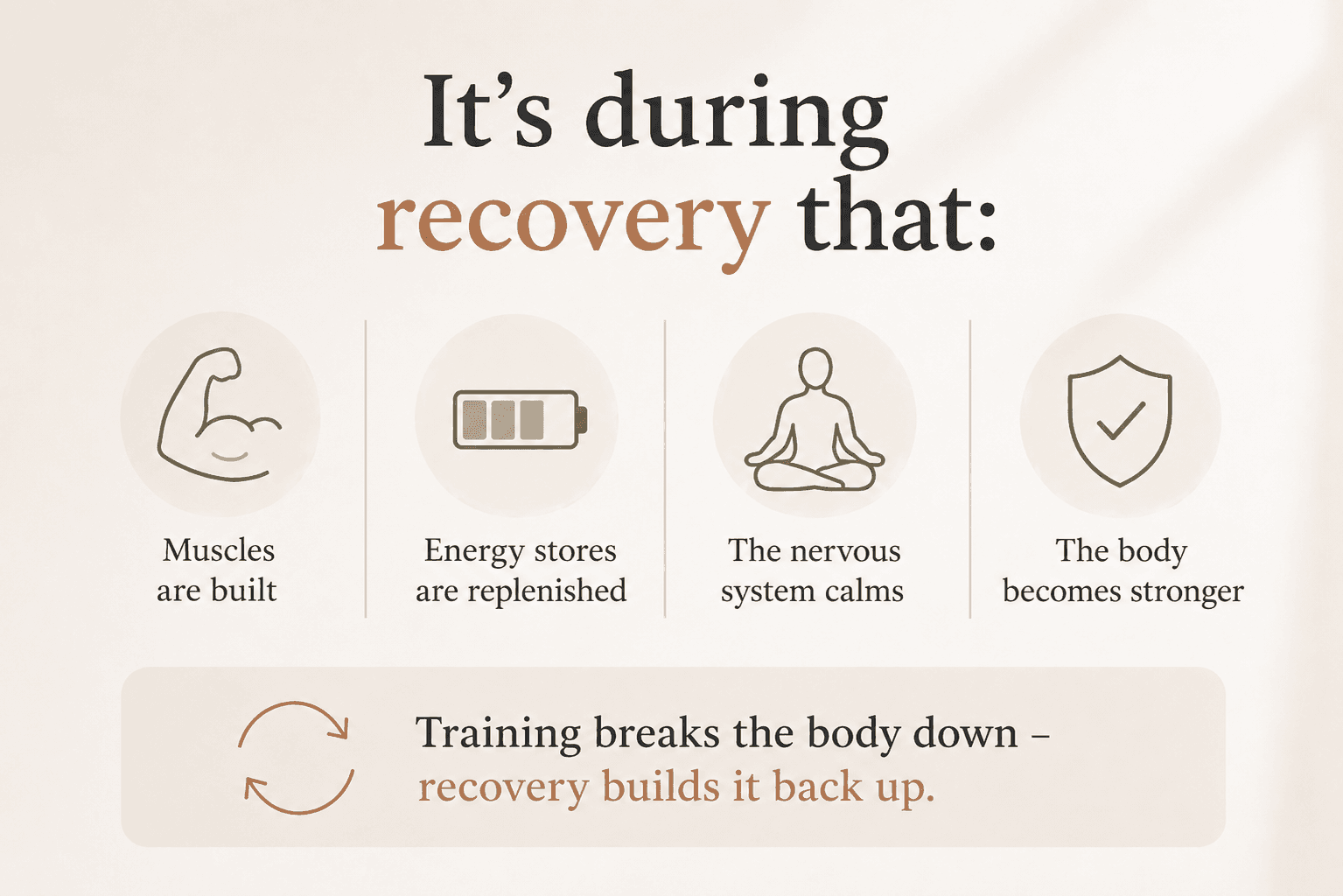
Recovery is when:
Muscles are rebuilt
Energy stores are replenished
The nervous system calms down
The body becomes stronger
Training breaks the body down—recovery builds it back up.
Active vs. Passive Recovery
Recovery is not just about lying still (although that’s important too ❤️).
There are two types of recovery:
🚶♀️ Active Recovery
Low-intensity movement that increases blood circulation without placing additional stress on the body.
Examples include:
Walking
Yoga
Stretching
Easy-paced cycling
Mobility training
Activities that help you relax mentally
😴 Passive Recovery
Complete rest—allowing the body to fully relax and recharge.
The most important form of passive recovery is sleep. Other examples include:
Power naps
Meditation or breathing exercises
Taking a bath
Simply being—without any pressure to perform
Both types of recovery are important. It’s all about finding the right balance.
How Much Recovery Do You Need? 🛌
There’s no exact answer, but here are some clear guidelines to help you find the right balance:
💤 Sleep (the foundation of everything)
Aim for 7–9 hours of sleep per night
Try to maintain consistent sleep and wake times
Prioritize sleep quality, not just the number of hours
🏋️♀️ Training & Rest
Take 1–2 rest days per week
Vary the intensity of your workouts
Listen to your body—not just your schedule
🧠 Mental Recovery (just as important!)
Make time for it every day—even if it’s only 10–15 minutes
Spend some time away from screens
Do something that genuinely helps you relax and unwind
How to Make Recovery Part of Your Daily Life 🌿
Recovery doesn’t have to be complicated. It’s about making small, intentional choices.
Here are some practical ways to get started:
Take a walk without your phone
Spend 10 minutes stretching after your workout
Turn off notifications for a while each day
Go to bed 30 minutes earlier
Schedule rest days—just like you schedule your workouts
An Important Reminder ❤️
You do not become stronger by constantly pushing yourself.
You become stronger through the balance between training and recovery.
Resting is not being lazy—it is an essential part of the process. ✨
 Anna Stålnacke